
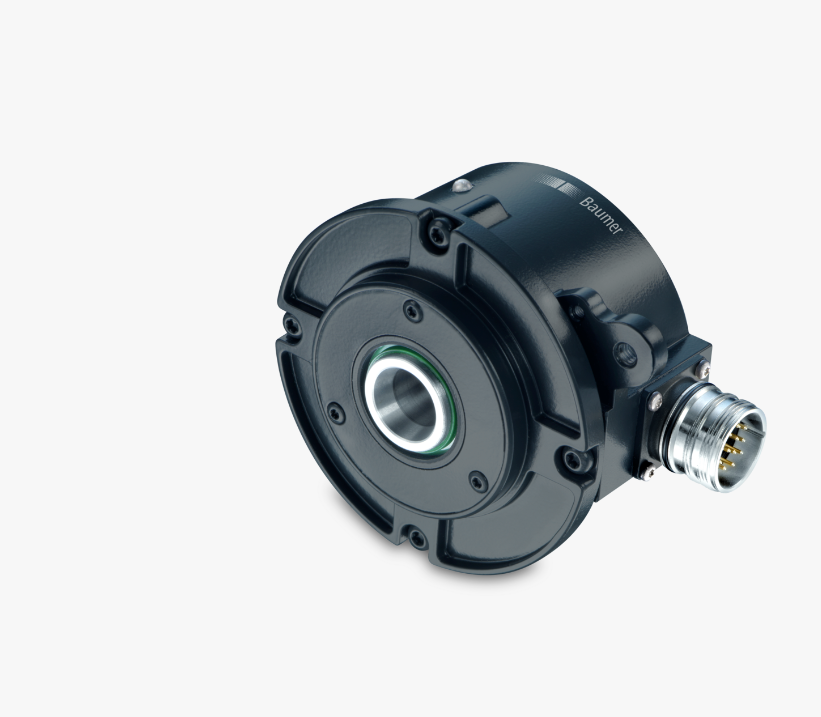

The Baumer OG9 DN 1024 I rotary encoder stands out as a high-performance feedback device designed for applications that demand exceptional signal quality, outstanding durability, and precise rotational measurement. As industrial environments continue evolving and automation systems grow more complex, engineers search for encoders that ensure reliability, efficiency, and seamless integration. Consequently, the OG9 DN 1024 I becomes an ideal option for users who require robust construction, accurate pulse output, and long-term operational stability.
To begin with, the encoder delivers a standardized 1024 pulses per revolution (PPR) resolution, which offers an excellent balance between signal clarity and processing efficiency. Because many control systems operate within this resolution range, the encoder fits a wide variety of automation architectures. Furthermore, the OG9 DN 1024 I maintains its accuracy even when conditions fluctuate, and therefore engineers can trust the encoder to support stable speed control, precise motor synchronization, and consistent positioning tasks.
Moreover, the device incorporates advanced optical sensing elements. This design choice ensures clear signal generation while reducing susceptibility to electrical noise. Since electrical interference often affects industrial environments, the encoder’s internal engineering minimizes signal distortion and maximizes data integrity. Therefore, automation systems using the OG9 DN 1024 I maintain a smoother and more predictable performance curve.
Additionally, manufacturers recognize Baumer’s reputation for producing rugged components, and the OG9 DN 1024 I continues this tradition. Its housing withstands harsh environmental conditions, including dust exposure, mechanical vibration, and temperature variations. Because of this durability, the encoder maintains dependable functionality even when operating continuously for extended periods. Users who value reliability appreciate the stable output signals and consistent mechanical robustness.
When integrating the device into automation systems, engineers find the connection interface straightforward. The OG9 DN 1024 I typically includes a standardized output circuit design that supports differential signals, allowing long-distance signal transmission without significant degradation. Consequently, users install the encoder in a variety of setups, including conveyor lines, CNC systems, robotics, packaging equipment, and industrial motors. The encoder’s flexibility allows it to serve as a multipurpose feedback device across numerous sectors.
Furthermore, as industries pursue higher productivity levels, the need for rapid response and fast system feedback continues increasing. Because the OG9 DN 1024 I provides highly responsive pulse generation, control loops perform dynamic adjustments quickly. Therefore, automation platforms achieve more precise servo performance, smoother acceleration curves, and improved speed regulation. This enhances overall process quality and reduces operational inefficiencies.
Engineers also appreciate the encoder’s compact mechanical structure. Even though the device offers robust protection, its form factor allows easy installation in equipment with limited mounting space. Since many modern machines require streamlined component placement, the Baumer OG9 DN 1024 I supports efficient design layouts. Its mounting system ensures stable shaft coupling, and technicians complete installation procedures confidently.
In terms of maintenance considerations, the encoder requires minimal service attention. Because its optical sensing components operate without physical wear and the housing protects against contamination, users enjoy extended operational life. As a result, downtime decreases and maintenance schedules become more predictable. Furthermore, the steady performance curve ensures that systems remain accurate over long periods, reducing recalibration needs.
Moreover, modern industrial plants focus increasingly on data-driven decision-making. Because of this trend, reliable feedback signals become essential for monitoring, diagnostic processes, and predictive maintenance. The OG9 DN 1024 I contributes high-quality feedback that supports advanced digital control systems. Whether engineers analyze rotation speed, phase alignment, or shaft positioning, the encoder supplies stable digital pulses for processing.
Additionally, the encoder aligns well with Industry 4.0 requirements. Because smart factories emphasize precision, repeatability, and high-quality feedback loops, the OG9 DN 1024 I supports consistent automation flow. Integrating this encoder into modern platforms strengthens the connectivity between mechanical motion and digital control analytics. This synergy enhances operational transparency and improves overall production strategies.
Reliability also matters during extreme load cycles. Since many machines operate with sudden speed changes or frequent start-stop sequences, encoders must withstand rapid dynamic shifts. The OG9 DN 1024 I excels in such environments because of its tough mechanical build and stable signal output. Consequently, the encoder suits servo motors, spindle drives, and variable-speed systems where reliability directly impacts production quality.
Furthermore, engineers choose this encoder to enhance safety systems. In safety-critical environments, precise motion detection prevents mechanical errors, reduces system faults, and improves operator protection. Because the OG9 DN 1024 I supplies clear and consistent pulses, control systems react quickly to real-time motion information. This responsiveness enhances machine safety and maintains consistent operational integrity.
The encoder also supports flexible integration with PLCs, servo drives, and motion controllers. Since it provides industry-standard output formats, technicians connect it seamlessly using existing wiring practices. Moreover, its signal compatibility works well with both legacy and modern automation architectures, allowing users to upgrade systems without redesigning entire feedback loops.
In addition, the OG9 DN 1024 I delivers excellent shaft compatibility. Whether engineers require solid shaft variants or hollow-shaft mounting solutions, the encoder adapts to various mechanical configurations. This wide compatibility enables creative design freedom for machine builders. They select the appropriate mounting approach based on spatial constraints and rotational requirements.
Durability becomes especially important in facilities that operate under round-the-clock workloads. Because the Baumer OG9 DN 1024 I maintains stable output throughout continuous operation, businesses minimize production interruptions. Additionally, the encoder provides high shock and vibration tolerance, preventing mechanical disturbances from affecting signal quality. This strength makes the encoder suitable for heavy-duty machinery and harsh industrial sectors.
Modern automation also requires encoders with consistent temperature performance. Since many industrial environments experience temperature fluctuations, the encoder’s internal design ensures stable operation across a wide temperature range. Consequently, performance remains reliable regardless of thermal conditions, and users depend on the encoder for year-round operation.
Another significant advantage involves the encoder’s low power consumption. Because energy-efficient designs help reduce overall system load, the OG9 DN 1024 I contributes to sustainable operating strategies. Plants that prioritize energy optimization appreciate this characteristic, especially when integrating multiple encoders into large automation networks.
Furthermore, the Baumer brand adds strong credibility. Since Baumer consistently demonstrates commitment to engineering excellence, users trust the OG9 DN 1024 I to deliver long-term performance. Combined with well-established global support and high-quality manufacturing standards, the encoder serves as a dependable solution for both new installations and system upgrades.
Overall, the Baumer OG9 DN 1024 I encoder forms a critical component for precision control applications. It integrates robust construction, high signal accuracy, simple installation, and versatile compatibility. Because automation environments demand stable and accurate motion feedback, the encoder stands out as a strong choice for manufacturers who value reliability, clarity, and long-term operational success.
As industries continue prioritizing efficiency and intelligent control, the OG9 DN 1024 I strengthens automation platforms with precise feedback and strong mechanical resilience. Therefore, engineers and machine builders can confidently rely on this encoder to support advanced motion tasks, enhance productivity, and maintain superior operational quality across diverse industrial applications.
Related products
Products
Products
Products
Products
Products
Products
Products
Products