
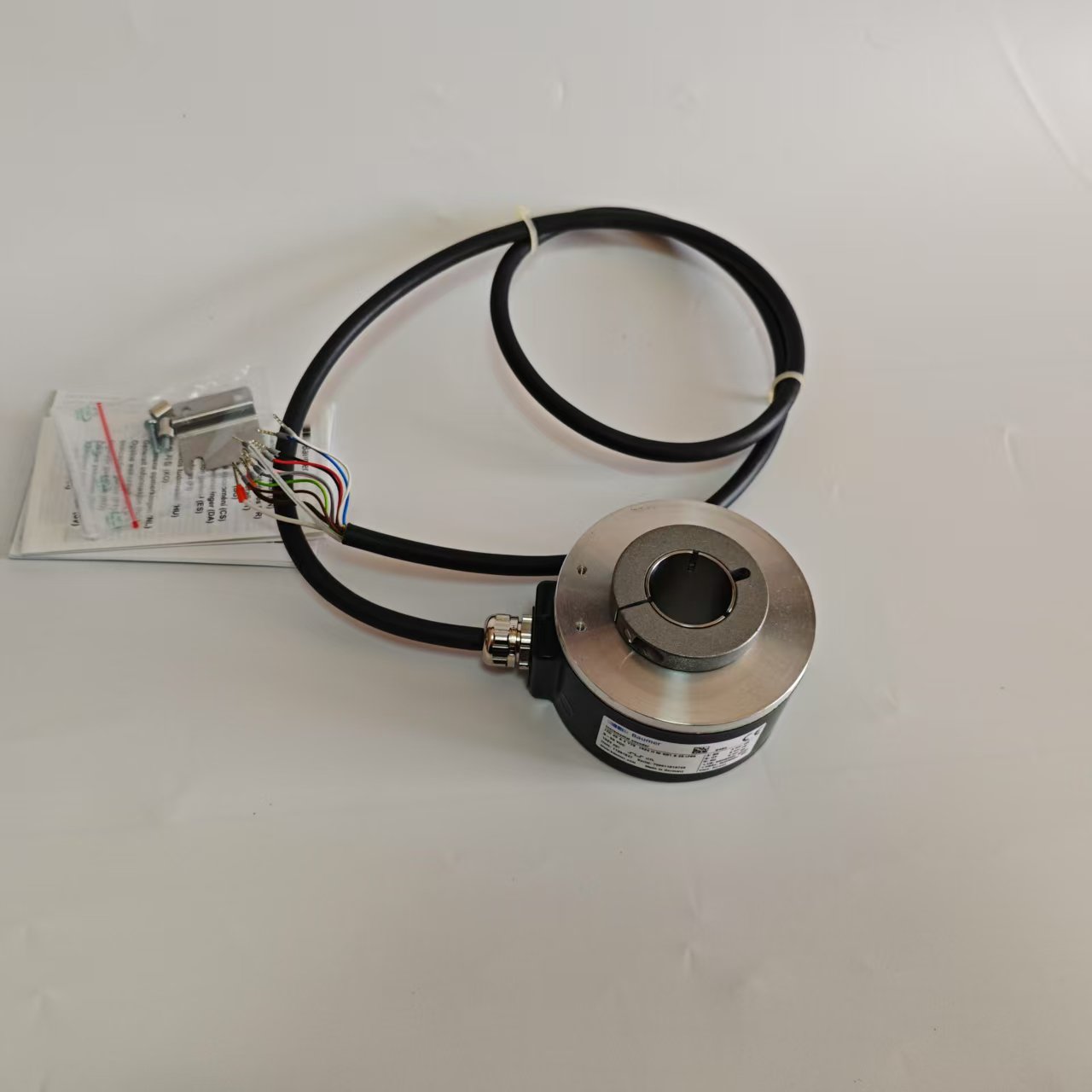

Baumer Encoder HOG10 DN 1024 I LR 16H7 + FSL6 – Detailed Technical and Application Guide
The Baumer HOG10 DN 1024 I LR 16H7 + FSL6 encoder provides reliable incremental feedback for demanding industrial applications where accuracy, durability, and consistent output remain essential. Because modern automation systems continue to evolve rapidly, industries seek encoder solutions that support high-speed operations, long service life, and stable integration. Consequently, this encoder offers a comprehensive combination of mechanical strength, optimized sensing performance, and flexible mounting compatibility. Throughout the following sections, each major aspect of the encoder is explained in detail so engineers and system designers gain a complete understanding of how it improves machine operation and workflow efficiency.
Mechanical Structure and Robust Design
Although the encoder remains compact, its mechanical structure enhances long-term reliability in challenging environments. The robust housing protects internal components from dust, oils, and airborne contaminants, while high-grade sealing elements prevent intrusion during continuous operation. Moreover, the device supports significant radial and axial shaft loads, since its bearing system uses optimized materials and precision construction.
The LR 16H7 shaft design contributes to stable mounting alignment. Because shaft tolerances influence pulse accuracy, this mechanical interface ensures smooth rotation, reduced vibration, and consistent output across long production cycles. Additionally, engineering teams benefit from mounting stability during both low-speed and high-speed operations, which leads to improved feedback reliability in servo systems, conveyor motors, and industrial drives.
The FSL6 component enhances installation convenience, offering additional mechanical support and improved coupling flexibility. Consequently, the encoder adapts to diverse mechanical configurations without requiring major system modifications.
Incremental Output Performance and Signal Reliability
Since incremental feedback must remain precise under variable load conditions, the HOG10 DN 1024 I LR 16H7 + FSL6 uses advanced sensing technology to produce clean and consistent pulses. The “I” designation indicates incremental output, while the 1024 PPR resolution delivers precise tracking of rotational movement.
Through A, B, and Z channels, industrial controllers interpret speed, direction, and reference zeroing with high accuracy. Furthermore, the output signal maintains clarity even in electrically noisy environments, since Baumer integrates refined shielding and optimized circuitry into the encoder’s internal design. As a result, the pulse edges remain sharp, which ensures accurate calculations for velocity control, position tracking, and motor synchronization.
Moreover, the encoder operates effectively across a wide range of speeds, which allows it to support both high-inertia systems and applications requiring rapid acceleration. Because machine performance depends on real-time monitoring, stable incremental pulses help controllers execute precise adjustments that improve overall process efficiency.
Resolution, Accuracy, and Motion Control Benefits
The 1024-pulse resolution of the HOG10 DN 1024 I serves as a balanced level for both speed control and position measurement. Although higher resolution encoders exist, many industries select 1024 PPR because it offers fast data refresh rates while maintaining motion detail that suits most automated processes.
Additionally, the encoder maintains accuracy across temperature changes, mechanical stress, and dynamic load conditions. Since industrial machines often operate under vibration or fluctuating speeds, stable pulse generation becomes crucial for maintaining consistent output. The encoder’s optical sensing method therefore offers strong reliability, which enhances control system performance in robotics, automated assembly lines, and transportation mechanisms.
Through this resolution level, external controllers also perform interpolation to achieve finer virtual positioning. Consequently, high-precision motion control becomes more achievable even when the encoder itself outputs a standard 1024 PPR signal.
Environmental Resistance and Industrial Endurance
Industrial environments introduce multiple stresses that can compromise sensor performance. Because of this, Baumer designs the HOG10 DN 1024 I LR 16H7 + FSL6 with strong environmental resistance. The rugged housing protects the optical components from foreign particles, while sealing rings prevent lubricant ingress from nearby machinery.
Moreover, the encoder withstands substantial temperature variations, which allows it to operate reliably in hot manufacturing zones or cold storage environments. The durable mechanical framework tolerates continuous vibration, making the encoder suitable for heavy-duty equipment such as metal processing machines, industrial lifts, large motors, and automated handling systems.
Additionally, long-term operational cycles do not significantly impact the encoder due to high-precision bearings and optimized internal structure. Because downtime creates high maintenance costs, industries prefer components that maintain performance through extended use, and this encoder meets those expectations.
System Integration and Mounting Flexibility
The HOG10 DN 1024 I LR 16H7 + FSL6 integrates easily into existing automation systems due to its standardized connections and mechanical interfaces. Furthermore, wiring remains simple, since the device uses clearly defined channel outputs and consistent pin assignments.
The LR 16H7 shaft interface suits many common industrial drive assemblies, allowing engineers to mount the encoder without reworking mechanical structures. Additionally, the FSL6 accessory enhances alignment flexibility and improves the installation process during upgrades or system expansions.
Because control systems often rely on a variety of encoder formats, the incremental output ensures compatibility with PLCs, servo drives, motor controllers, and advanced automation platforms. Consequently, integration requires minimal configuration adjustments, which shortens installation time.
Application Areas and Practical Use Cases
This encoder serves a wide range of mechanical and automation environments. Its stability, accuracy, and resistance to harsh conditions make it suitable for many industries:
Servo Motor Feedback Systems
Servo applications need precise incremental pulses to maintain speed and torque regulation. The encoder delivers fast response, which improves motor stability.
Automated Manufacturing Lines
Packaging, cutting, labeling, and assembly equipment require accurate movement timing, and the encoder enhances synchronization and machine coordination.
Material Handling and Conveyors
Conveyor motors benefit from consistent speed regulation and stable pulse output, which improves throughput and reduces errors.
Robotics and Positioning Systems
Robotic arms and gantry systems rely on accurate incremental feedback to maintain movement precision.
Textile, Paper, and Printing Machinery
Industries that depend on repetitive, high-speed processing benefit from the encoder’s stable resolution and noise-resistant signal quality.
Through these examples, it becomes clear why the HOG10 DN 1024 I LR 16H7 + FSL6 supports such a wide variety of industrial operations.
Reasons Engineers Prefer the Baumer HOG10 DN 1024 I LR 16H7 + FSL6
The encoder offers several benefits that simplify engineering tasks and improve system performance:
-
Strong mechanical housing for industrial durability
-
Accurate incremental pulses at 1024 PPR
-
LR 16H7 fitting ensures mounting stability
-
FSL6 accessory improves installation flexibility
-
Clean signal output resistant to electrical interference
-
Wide compatibility with automation controllers
-
Stable performance across various environmental conditions
-
Long service life with reduced maintenance demands
These characteristics make the encoder a dependable choice for companies that prioritize precision, reliability, and workflow efficiency.
Conclusion
The Baumer HOG10 DN 1024 I LR 16H7 + FSL6 encoder delivers strong incremental feedback, mechanical stability, and long-term durability across many industrial environments. As automation requirements continue to increase, having an encoder that offers consistent accuracy and easy integration becomes essential. Because this model meets those expectations, it remains widely used in high-demand sectors.
Through its robust structural design, high-quality pulses, and flexible mounting options, the encoder supports continuous workflow improvement and reliable machine performance. Therefore, companies that adopt the HOG10 DN 1024 I LR 16H7 + FSL6 benefit from enhanced motion control, stronger operational efficiency, and reduced downtime.
Related products
Products
Products
Products
Products
Products
Products
Products
Products